How Website Performance Can Affect Google Ads Performance
Website performance is not only about making a website load faster. For developers running online advertising campaigns, performance can also become an important part of the overall advertising experience. A website may have a good advertisement, but if the landing page is slow, difficult to navigate, poorly optimized for mobile devices, or unavailable, the advertising campaign may not achieve its full potential.
Website Performance Is More Than Just Speed
When developers talk about website performance, the discussion often focuses on loading speed. However, performance includes several technical and user-experience factors.
- Page loading speed
- Mobile responsiveness
- Server response time
- Image optimization
- JavaScript and CSS efficiency
- Database performance
- Hosting reliability
- Website availability
- Navigation and usability
- Landing-page quality
These factors become particularly important when a website is used as the destination of a paid advertising campaign.
Why Website Performance Matters for Google Ads
Google Ads does not operate independently from the website receiving the visitors. When someone clicks an advertisement, the user is redirected to a landing page. The quality of that experience matters.
A visitor who clicks an advertisement expects the destination page to load quickly, display correctly, and provide the information promised by the advertisement.
A slow or unreliable website can create a poor user experience. Even when the advertisement itself is well designed, the campaign can lose potential value if visitors cannot comfortably use the destination website.
The Connection Between Website Performance and Advertising
Consider a simple advertising flow:
          Advertisement
                ↓
          User clicks
                ↓
          Landing Page
                ↓
          Website Experience
                ↓
          User Action
The advertisement is only the beginning of the process. The website becomes responsible for the next stage of the user's journey.
This is why developers should not treat advertising as something that happens completely separately from website development.
Preparing a Website Before Launching Google Ads
Before launching an advertising campaign, I believe developers should first make sure that the website is ready to receive traffic.
- Responsive design
- Fast page loading
- Working navigation
- Clear website structure
- Privacy Policy
- Contact page
- Useful and original content
- HTTPS configuration
- Reliable hosting
- Working links and buttons
My Website Deployment Experience
This article is also based on my own experience developing and maintaining a website while preparing it for online advertising. Instead of treating the website as a static project, I started looking at it as an evolving digital product that requires continuous improvement and maintenance.
The website eventually reached the stage where Google Ads deployment became part of the project. This introduced another important consideration: advertising is not simply about creating a campaign and waiting for results.
The website itself needs to be maintained, monitored, improved, and prepared for the traffic generated by the campaign.
Google Ads Deployment
The Google Ads deployment became an important milestone for the project. At this point, the website was no longer being treated only as a development exercise. It was being prepared as an actual platform that could receive visitors from a paid advertising source.
The deployment process also provided an opportunity to observe how the website, advertising system, and available performance data could work together.
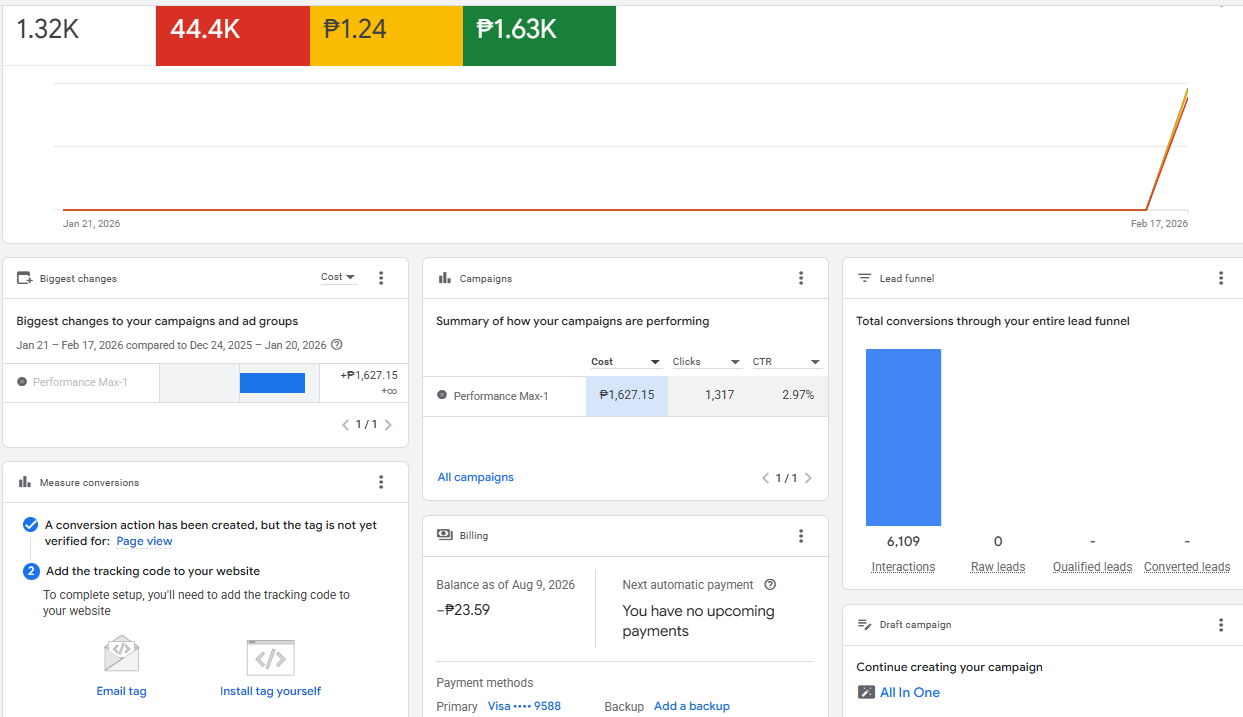
Three-pillar overview of the Google Ads project during the January to February 2026 period.
The three-pillar view provides a useful way to understand the major components being observed during the project: the changes occurring within the account, the campaign activity, and the performance trend over time.
Monitoring the Biggest Changes
One of the useful views when analyzing advertising activity is the identification of the biggest changes during a specific period. For this project, the period being examined covers January to February 2026.
.png)
Biggest changes observed during the January to February 2026 period.
The biggest-changes view helps identify which metrics or activities changed during the selected period. Instead of looking at a single number, developers can use this information to understand how the advertising project is evolving.
Campaign Performance
Campaign-level information provides another perspective. It allows the developer or advertiser to examine how the campaign itself performed during the selected period.
.png)
Google Ads campaign performance during the January to February 2026 period.
This type of information is useful because advertising performance should be evaluated using actual data rather than assumptions.
A campaign can be technically deployed while still requiring additional optimization, testing, or strategic planning before becoming a larger advertising investment.
Understanding Performance Over Time
A time-series view provides a different perspective from a single campaign snapshot. Instead of asking what happened at one particular moment, it allows us to observe how performance changed throughout the selected period.
.png)
Time-series view showing performance changes from January to February 2026.
The January to February 2026 period became useful for observing the development of the project and understanding how different activities were reflected in the available data.
Why I Postponed the Google Ads Campaign
One of the most important decisions in this project was postponing the next stage of the Google Ads campaign.
The decision was not because advertising was abandoned. Instead, the campaign was postponed so that the website could continue improving before additional advertising investment was made.
This is an important lesson for developers who want to turn websites into real digital products: launching an advertising campaign does not automatically mean that the project is ready to scale.
Sometimes the better decision is to pause, improve the product, strengthen the website, collect more information, and then continue the campaign when the next stage of the project is ready.
Maintenance Is Part of the Investment
Running a website also creates maintenance requirements. Hosting, domain services, development work, content creation, technical improvements, monitoring, and advertising can all become part of the project's operating costs.
Because of this, website development should not be viewed as a one-time expense. A production website is a continuously maintained system.
In my experience, even when an advertising campaign is temporarily postponed, the website still needs investment to remain functional, updated, secure, and ready for the next stage.
Performance Optimization Checklist
Before sending more paid traffic to a website, developers can use the following checklist:
- Optimize large images
- Use modern image formats such as WebP
- Minify CSS and JavaScript
- Enable browser caching
- Use a CDN when appropriate
- Reduce unnecessary HTTP requests
- Enable lazy loading for suitable images
- Optimize database queries
- Use indexes for frequently queried database columns
- Monitor server performance
- Use reliable hosting
- Test mobile responsiveness
- Check broken links
- Verify landing pages before launching campaigns
Performance Testing Tools
Developers can use several tools to evaluate website performance before and during an advertising project.
- Google PageSpeed Insights
- GTmetrix
- Lighthouse
- Browser Developer Tools
What I Learned From the Project
The biggest lesson from this project is that development, deployment, advertising, and maintenance are connected.
A developer may successfully build a website, but that does not mean the project is finished. Once real users and paid traffic are involved, the website becomes an operational product that must be monitored and continuously improved.
The Google Ads deployment also provided a practical opportunity to understand the relationship between technical development and digital marketing. Performance data can help guide decisions about when to continue, optimize, or temporarily postpone an advertising campaign.
Conclusion
Website performance can play an important role in the overall Google Ads experience because users who click advertisements ultimately interact with the destination website.
Fast loading, reliable hosting, responsive design, optimized content, and a well-prepared landing page can help create a better experience for visitors arriving through advertising.
My January to February 2026 experience also showed that advertising should be treated as part of a larger development cycle. Sometimes the right decision is not to immediately increase spending, but to improve the website, analyze the available data, manage maintenance costs, and prepare the next stage of the project.
The goal is not simply to run advertisements. The goal is to build a website that is technically prepared, useful to visitors, measurable, maintainable, and ready to grow.
📖 1,290 Words